Ten Commandments for Church Reform
by John Wijngaards
10 November 2021
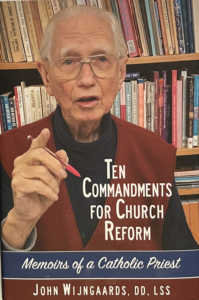 The Catholic Church needs to be updated. Pope Francis has opened a procedure for dialogue. His Synodal Process began on the 17th of October this year by diocesan synods deliberating about the situation in the Church. This opportunity should be fully exploited. But it means that we should have the courage to firmly grasp the nettle by the hand. In a new book, Ten Commandments for Church Reform, I outline some of the issues that need to be tackled. And I speak from experience.
In November 2002 I visited Australia on a lecture tour. The parish council of St Vincent de Paul’s Catholic Church at Redfern in the heart of Sydney invited me to speak to their community after Sunday Mass. I had just published a book on the ordination of women and that was the topic they wanted me to address. But the Archbishop of Sydney, George Pell – the present Cardinal Pell -, got word of it. He had been made a bishop by Pope John Paul II partly because of his opposition to women in the priesthood. Pell was reputed to have said on one occasion: “Ordain a woman? You might as well try to ordain a potato!”
When I arrived at the church door on that sunny Sunday morning I was stopped by two wardens. The archbishop had left instructions that on no account was I to be allowed to enter the building. So I spent the next hour and a half sitting on a bench in a nearby park playing with some aboriginal children. Fortunately, when the congregation emerged after mass a section of them took me to a large ‘coffee house’ where they could listen to my talk.
I am telling this story because it illustrates three urgent problems the Church needs to address.
Research has clearly shown that the exclusion of women from the priesthood was due to cultural prejudice, not to gospel teaching. In fact, both men and women were present at the Last Supper when Jesus said to all: “Do this in memory of me!” And during the first millennium women no less than men were sacramentally ordained deacon. The devotion to Mary as Priest flourished in the Church for nineteen centuries – and the mother of Jesus was after all a woman. Banning women from the priesthood is an antiquated error that should be immediately overturned.
Secondly, recent popes before Pope Francis have seriously undermined the exercise of authority in the Church. Their practice of only appointing ‘yes-men’ instead of real pastoral leaders led to the hierarchy failing to expose paedophile priests as criminals subject to State penalties. Cardinal Pell himself, though personally acquitted of sexual abuse, was in May 2020 found guilty by an Australian Royal Commission of shielding clergy who had committed sexual abuse. The Church has to return to the ancient practice of the local clergy and faithful electing candidates for the episcopacy. The local community should have a voice in saying who should be their bishop.
Then there is the issue of suppressing criticism by competent persons. Theologians who express disagreement with statements by popes or by henchmen in the Vatican have been sacked from teaching posts in Catholic institutions, such as universities, colleges, seminaries. Their names have been entered on Vatican blacklists of dissenters ‘suspected of heresy’ – as was done in my case. But this seriously damages the charism of ‘prophecy’ in the Church as Karl Rahner frequently pointed out, a charism as important as the gift of ‘administration’ (1 Corinthians 12,1-31). And the Second Vatican Council clearly decreed: “All the faithful, both clerical and lay, should be accorded a lawful freedom of inquiry, freedom of thought and freedom of expression” (Gaudium et Spes, no 62). It is also part of the Church’s official lawbook (Canon Law no 212 § 3).
The Diocesan Synods
The process Pope Francis has initiated envisages three stages: deliberations by diocesan synods this year, then consultation on continental basis, finally a central international synod by bishops in Rome.
It is crucial that members of the diocesan synods take their task seriously. They must recognise that the Church has made itself unacceptable to many thinking people for good reasons. They should list these problems and then rigorously examine them. Then they should adopt firm recommendations and resolutions.
In the first part of this essay I have only highlighted three issues that cry out for reform. There are others. Another major problem is the Church’s unchristian negative approach to sex. The normal use of contraceptives in family planning is rejected. Celibacy is imposed on priests. Same-sex unions are forbidden. In my latest book which has just come off the press I describe in some detail how, in the course of my ministry, I came across such issues. I urge you to acquire a copy of the book: Ten Commandments for Church Reform. Memoir of a Catholic Priest (Acadian House Publishing, Lafayette LA 2021).
Going by previous experience I fear that conservative groups will try to derail a real consultative process. Evangelization? Ah – make the place of worship more attractive. Thus they will focus attention on trivial issues like determining where people sit in church, what hymns should be sung at Mass, what songbooks should be used…
During my sixty years ministry as a theologian I have had the chance of getting to know the Church on all continents. I have great admiration for all the wonderful work done by priests, religious and lay leaders worldwide. The Catholic Church is generally providing a worthwhile service to over a billion people. With its message of ‘God is Love’ it has the potential of liberating millions from various forms of slavery and of transforming lives from mindless misery to meaningful happiness.
I urge responsible leaders in parishes to help steer the process of reform in the right direction by submitting lists of the really urgent concerns to members of their local diocesan synod.
Dr John Wijngaards, founder of the Wijngaards Institute for Catholic Research, author of Ten Commandments for Church Reform. Memoir of a Catholic Priest (Acadian House Publishing, Lafayette LA 2021).