Church as Institute – under Greek thinking
Source texts
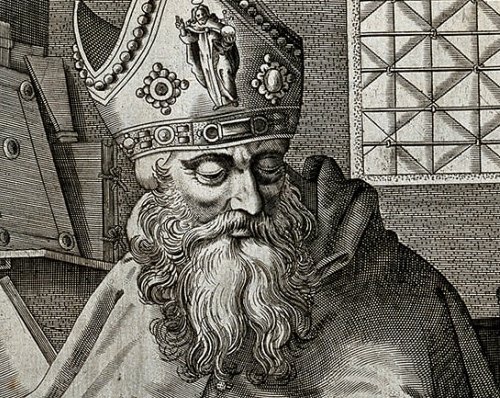
St Augustine
General Hellenistic/Platonic thinking
- In general, women were better treated in Hellenistic society than among the Romans. That is why, during the first millennium tens of thousands of ordained women deacons ministered in the Eastern part of Europe, while there was opposition to them in the Western Rome-dominated countries.
St Chrysostom (344-407). He accepted that women were subject to men. But, when he was patriarch in Constantinople, 40 ordained women deacons ministered in his basilica. And the chief one among them, St Olympias, was a close friend of his.
More information: https://womenpriests.org/tradition/chrysos-st-john-chrysostom/
- Some Greek thinkers, supported by Syriac Christians, saw the Holy Spirit in the Blessed Trinity as being female. This made God less masculine and gave women a better status. See St Ephraim (306-373).
Gnostic & Manichaean thinking
Some Gnostic sects rejected sex as an ‘animal feature’ to be avoided if at all possible. See the Gnostic Gospel of Thomas (2nd cent. AD). Information here: https://www.thebodyissacred.org/origin-opposition-spirit-flesh-gospel-of-thomas/
The Manichaean Religion (3rd cent. AD) was even worse. The prophet Mani taught that there were two opposing divine powers: the god of light and the goddess of darkness called Âz [= ‘lust’]. Âz created humankind filling them with lust and teaching them sexual intercourse More information here: https://www.thebodyissacred.org/origin-sexual-desire-creator-adam-eve-manichean-religion/
DISTORTION THREE – rejection of natural sexuality
St Augustine (354-430) was a convert from Manichaean religion, but he retained negative views about sexuality. Here is a summary of his views:
- Adam and Eve lost control over their genitals
- Every man’s seed is corrupted
- In paradise there was no sexual desire or pleasure
- In paradise God might have created children without the need of intercourse
- Spontaneous passion in our sexual organs is caused by sin
- Sexual passion during intercourse is the carrier of original sin
- Sexual desire, even in a good marriage, passes on original sin
- Jesus was not born from sexual intercourse, that is from ‘sinful flesh’
- Having children is the only worthy fruit of sexual intercourse
- Sexual intercourse in marriage not for begetting children is a venial fault
- A good Christian hates in his wife conjugal connection and sexual intercourse
- The perfect Christian couple live together as brother and sister
Full texts available here: https://www.thebodyissacred.org/origin-st-augustine-sexuality-sin-sex-pleasure/
As a Doctor of the Church, St Augustine has had a severe negative impact on Church teaching. Examples: the prohibition of artificial contraception, rejection of same-sex unions, enforced celibacy on priests in the Latin rite.
Thebodyissacred.org is one of the educational websites of the Wijngaards Institute
Aristotelian thinking
Aristotle (384-322 BC) was in many ways a genius. He invented many of the modern sciences. But his views about the nature of women were dismal. When Thomas Aquinas discovered him, via Arab scholars, he copied Aristotle’s views.
DISTORTION FOUR – women are a mishap of nature.
St Thomas Aquinas (1225 – 1274) taught the following about women:
- A MAN’s seed contains the future child. In procreation, a WOMAN only contributes her womb – which is like a ploughed field in which a grain of seed has been sown. The woman feeds the foetus.
- When a MALE child is born the birth is perfect. Every FEMALE child is born through an ‘accident’. (Quoting Aristotle:) ‘The semen is weak or the material [in the womb] is unsuitable, or because of the action of some external factor such as the winds from the south which make the atmosphere humid.’ But in God’s overall plan women do serve a purpose. They are useful for generation. After all, in his providence, God can even make use of ‘accidents’.
- Strictly speaking, every WOMAN is a ‘monster’ of nature. But the female sexual organs too will rise at the resurrection. For resurrection repairs the defects of nature.
- MAN has the greater power of reason. Because God ordered [= streamlined] him for intellectual activity. WOMEN are not ordered to intellectual operation. Though a WOMAN is carnally united to a man in generation, she is not united to him in his higher faculties.
- A MAN naturally commands authority. WOMEN are subject to men. For man is the beginning and end of WOMAN. Even a WOMAN’s hair is a sign of her subjection to man.
- MAN is in a state of perfection. MEN signify eminence in human nature. Therefore, it is MEN who can represent Christ at the Eucharist. WOMAN is in a state of subjection. The FEMALE SEX cannot ‘signify eminence of degree’ [= women cannot be the expression of perfect human nature]. Therefore, WOMEN cannot represent Christ at the Eucharist.
As a Doctor of the Church, hailed by Popes as a safe guide to understand Church doctrine, Aquinas played an important role in justifying patriarchy.
For more information and full academic references, go here: https://womenpriests.org/st-thomas-aquinas-1224-1274-ad-2/
Discussion in “Christ’s Idea of Authority in the Church”, chapters 7, 8, 9 and 23.
John Wijngaards