Qahal – Knesset
Source texts
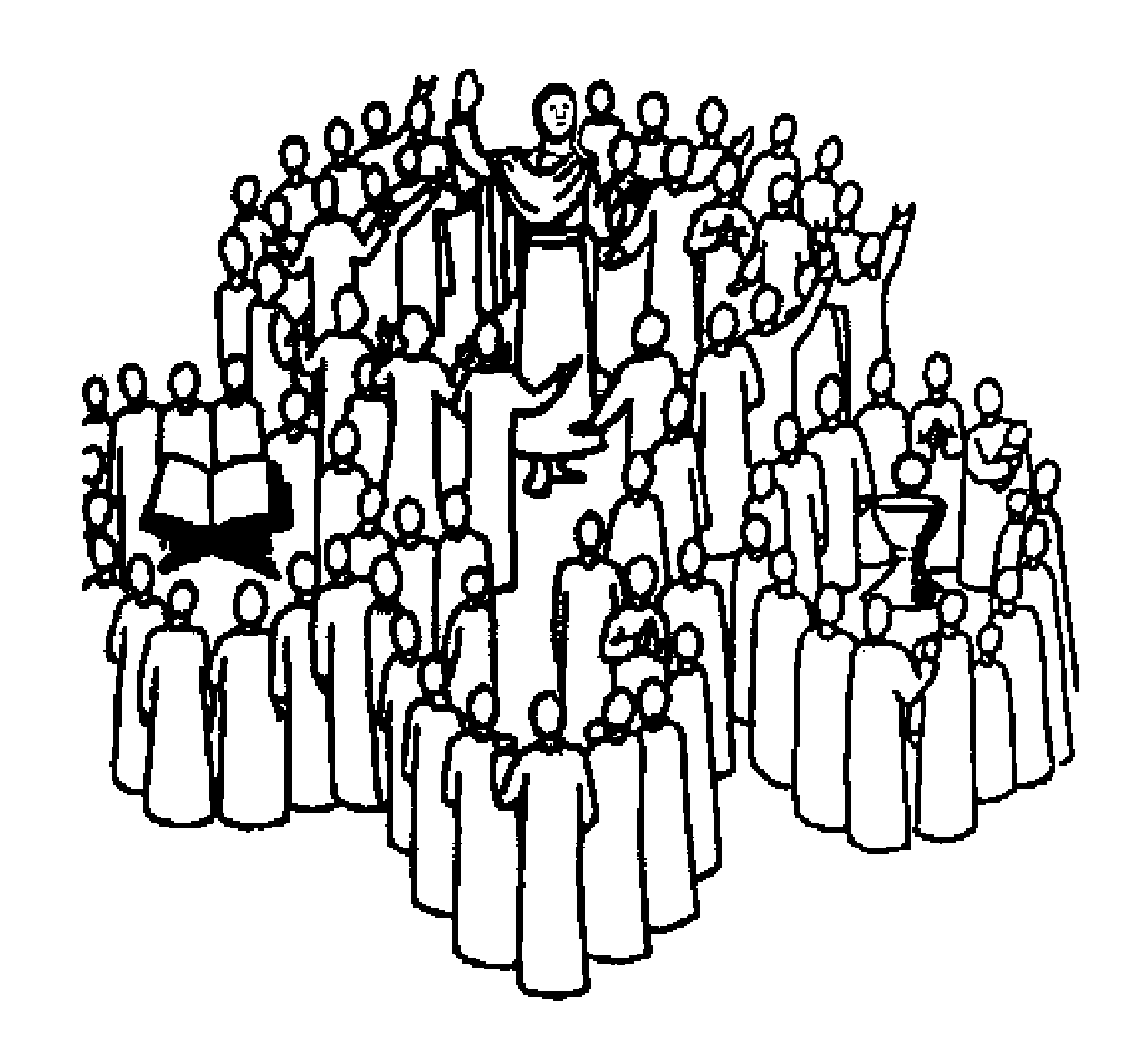 Mt 18/15-17 – If your brother sins against you, go and confront him privately. If he listens to you, you have won your brother over. But if you are unsuccessful, take one or two others with you and go back again, so that everything you say may be confirmed by two or three witnesses. If he refuses to listen to them, tell it to the church. And if he refuses to listen even to the church, regard him as you would a pagan or a tax collector.…
‘Church’ = ekklesia in Greek Matthew; qahal in Aramaic Matthew
The assembly after the exile
Solving mixed marriages
After return from the exile Ezra convokes the assembly to Jerusalem (Ezra 10,9-14). A decision is taken to dissolve the marriages between Jews and foreign wives.
“A proclamation was then issued throughout Judah and Jerusalem for all the exiles to assemble in Jerusalem.
Anyone who failed to appear within three days would forfeit all his property, in accordance with the decision of the officials and elders, and would himself be expelled from the assembly of the exiles.
Within the three days, all the men of Judah and Benjamin had gathered in Jerusalem.” (Ezra 10,7-9)
“The whole assembly responded with a loud voice: ‘You are right! We must do as you say’.” (Ezra 10,12)
Reintroducing the Tora (Nehemiah 8,1-18)
“All the people came together as one in the square before the Water Gate. They told Ezra the teacher of the Law to bring out the Book of the Law of Moses, which the LORD had commanded for Israel.
So on the first day of the seventh month Ezra the priest brought the Law before the assembly, which was made up of men and women and all who were able to understand.” Nehemiah 8,1-2
“Day after day, from the first day to the last, Ezra read from the Book of the Law of God. They celebrated the festival for seven days, and on the eighth day, in accordance with the regulation, there was an assembly.” Nehemiah 8,18
The assembly then takes a resolution re-accept the Tora as their law (Nehemiah 9-10)
Excluding foreigners from the assembly
“The Book of Moses was read aloud in the hearing of the people and there it was found written that no Ammonite or Moabite should ever be admitted into the assembly of God,
because they had not met the Israelites with food and water but had hired Balaam to call a curse down on them. (Our God, however, turned the curse into a blessing.)
When the people heard this law, they excluded from Israel all who were of foreign descent.” (Nehemiah 13,1-3)
The qahal in Jesus’ time
Qahal translated by the Septuagint as ‘ekklesia’ or ‘synagogue’.
In Jesus’ time each village or town had its synagogue – in Aramaic beit knesset or Qal (from qahal): a building to accommodate the community for listening to a reading of Scripture and prayer.
- Nine synagogues have been discovered by archaeology in Israel predating the Jewish-Roman war of 70 AD.
- A scribe was usually the teacher of the community. In some synagogues remnants of a stone seat have been found. This explains Jesus’ complaint: “The scribes sit on Moses’ seat. So observe everything they tell you. But do not do what they do, for they do not practice what they preach.” (Matthew 23,2-3)
- But the community took decisions as a whole body. When Jesus announced his ministry as the Messiah to the synagogue in Nazareth, the community rejected his claim. “All the people in the synagogue were furious when they heard this. They got up, drove him out of the town, and took him to the brow of the hill on which the town was built, in order to throw him off the cliff.” (Luke 4,28-29)
Jesus’ view of the community (qahal) of his disciples
Mt 18/15-17 – the local community adjudicates in disputes
Mt 16/16-18 – Simon Peter said, “You are the Messiah, the Son of the living God.” Jesus replied, “Blessed are you, Simon son of Jonah, for this was not revealed to you by flesh and blood, but by my Father in heaven. And I tell you that you are Peter [kephas = rock] , and on this rock I will build my church, and the gates of Hades will not overcome it.
- Here ‘church’ does not mean ‘church building’. It denotes the place where Jesus’ assembly will meet. Synagogues were built on a strong foundation – as archaeological sites actually bear out.
John Wijngaards